
Introduction
Want to chip and pitch the ball closer to the hole, with confidence? Most golfers know the frustration: the ball ends up short, long, or off line. To chip and pitch accurately, you need to know approximately where to land the ball on the green. Once you know your distance from the hole, the Essential Landing Zone System charts locate that landing zone quickly and easily, for any chip or pitch within 50 yards of the flagstick. The essential objective is simple: find the approximate landing zone so the ball lands and rolls out like a putt to the hole.
Preface: From the Range to the Green
As a teaching professional, Chaz H. Smith found that students loved the driving range — bucket after bucket, just to see how far the ball would go. He explained that the driver is used for only about 16% of all shots, while pitching, chipping and putting account for around 47%. When students shifted their practice time to the short game, they were thrilled at how much their accuracy and scores improved. ELZS is the product of years spent improving chipping and pitching accuracy for those students. It removes the one problem every golfer faces around the green — guessing where to land the ball — and makes the process simple, quick and fun.
The ELZS Charting System
ELZS is four charts, one for each green speed: Slow, Fast, Super Quick and Ultra Fast. Each works like a table. Distances from 5 to 50 yards run down the left side (with approximate meters alongside, and 15 to 150 feet as a quick reference). Clubs run across the top: 60°/58° lob wedge, 56°/54° sand wedge, 50°/49° gap wedge, pitching wedge, 9-iron, 8-iron, 7-iron, 6-iron, 5-iron, and hybrid/5-wood. Where your distance meets your club is your approximate landing zone. The charts allow a margin of error. You don't have to be precise, just accurate. The distances start at 5 yards because hole locations are usually set at least 5 yards (about 15 feet) from the edge of the green.
Knowing Green Speeds
Green speed is one of the most important variables in golf. It's measured with a stimpmeter, a tool used by golf course superintendents and PGA professionals: a ramp releases a ball onto a flat section of green, and the reading is how many feet it rolls. Slow-to-average greens read 8 and below. Fast greens read 9 to 10. Super Quick greens, like Augusta National's, read 11 to 12. Ultra Fast greens, like Oakmont Country Club's — where the stimpmeter was first used — read 13 to 15. Most recreational golfers play public courses running around 8 to 9. Stimpmeter readings mean the same thing on any grass: a 10 on bentgrass is a 10 on Bermuda. If you're not sure of the speed, ask the PGA Head Professional or the Golf Course Superintendent. They're usually happy to share it, along with the type of grass on the greens.
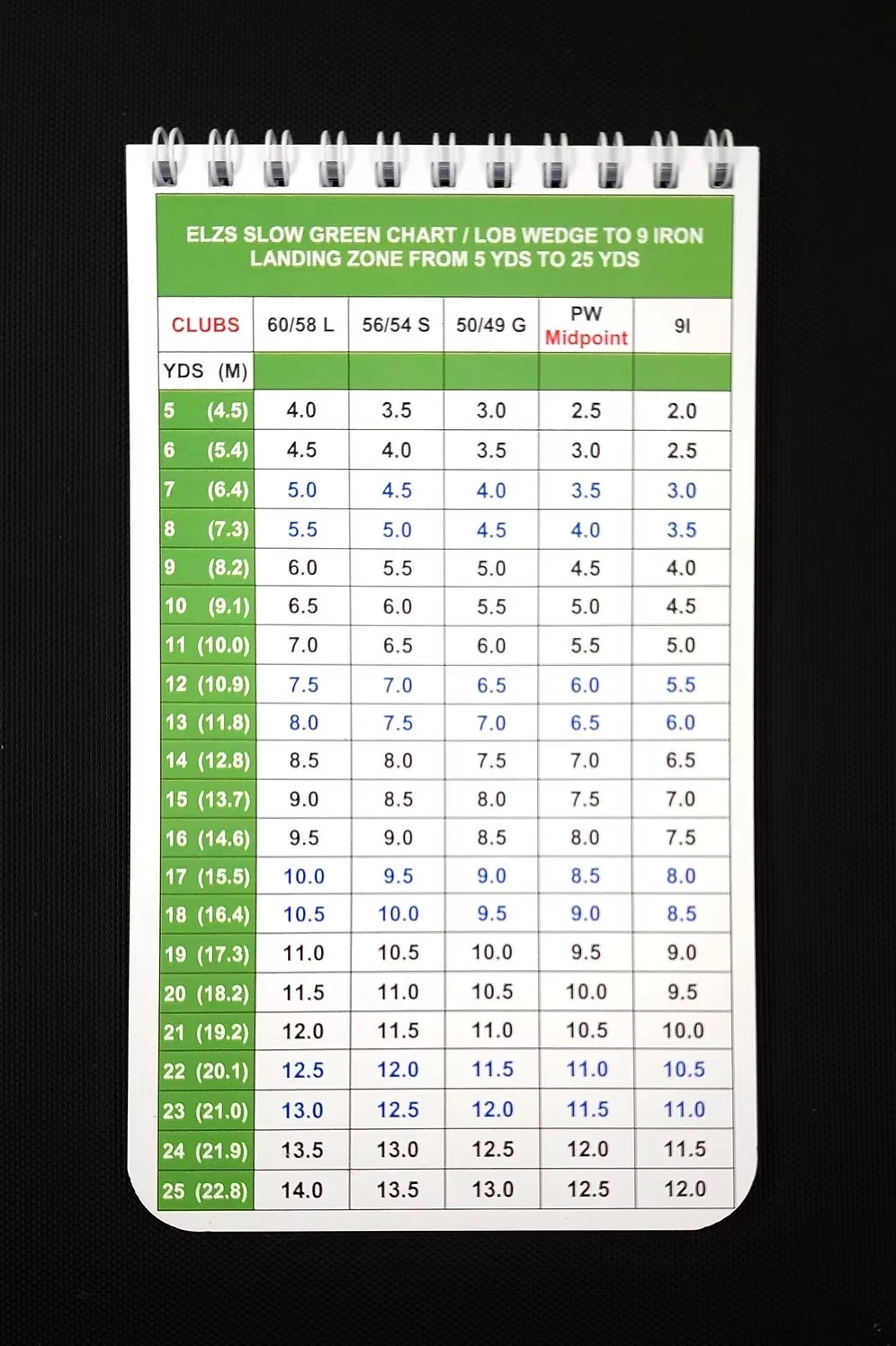
Slow
STIMP 8 & belowMost public and municipal courses.
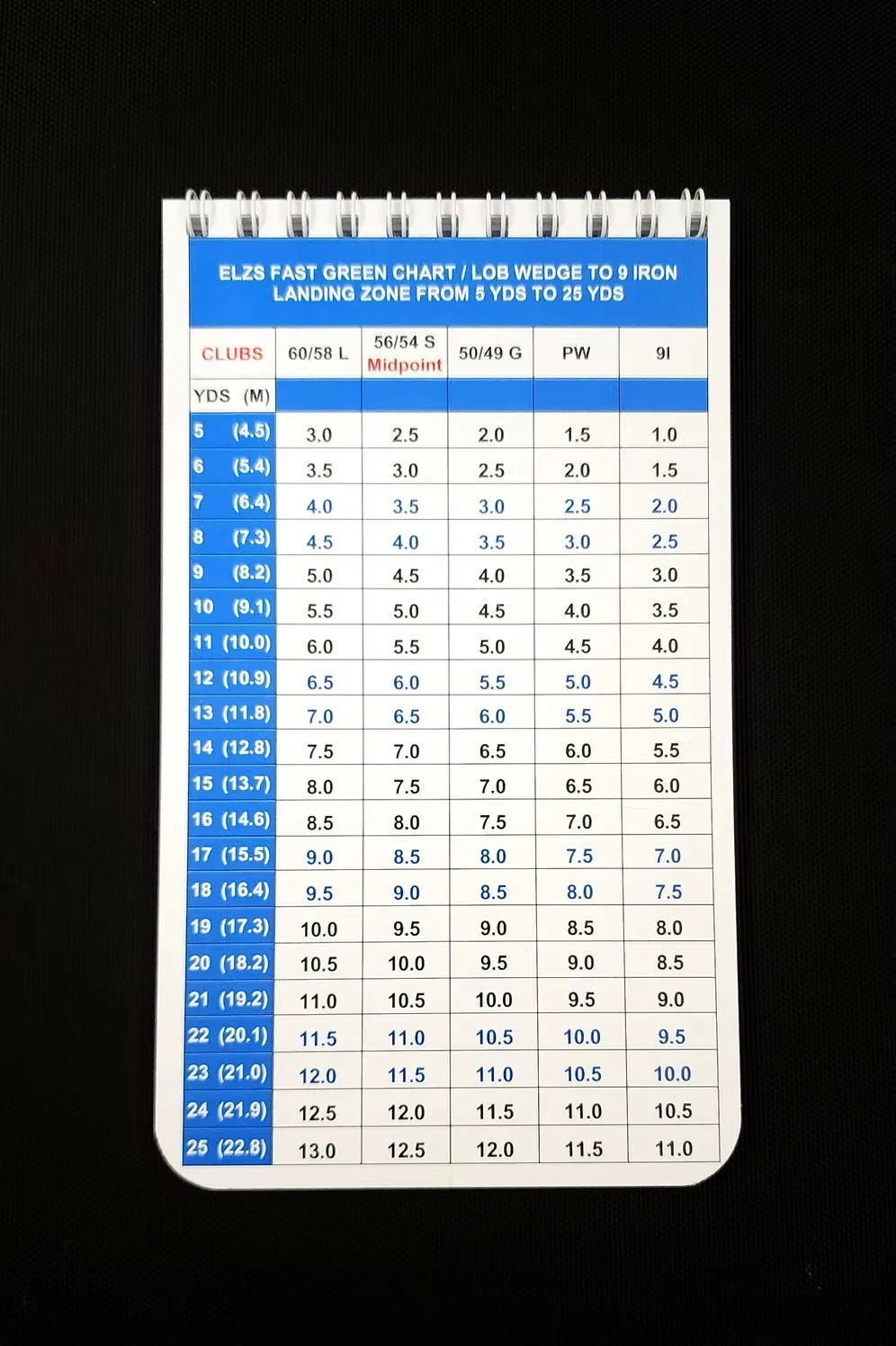
Fast
STIMP 9–10Well-kept clubs and resort courses.
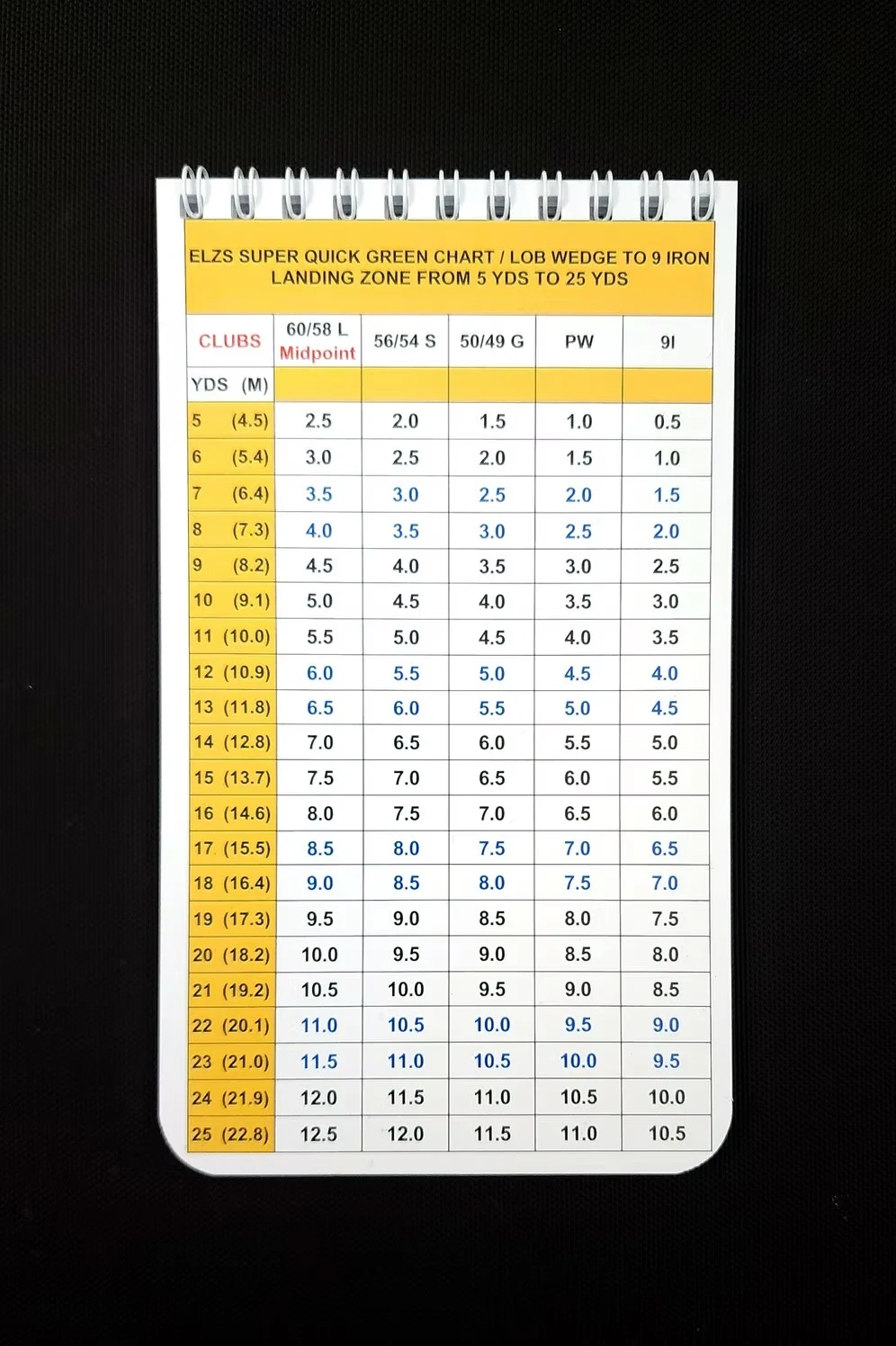
Super Quick
STIMP 11–12Tournament speed, like Augusta National.
Ultra Fast
STIMP 13–15Major-championship speed, like Oakmont.
Reading the Charts
Example 1: On the Fast chart, the ball is 18 yards from the hole and you're hitting a 50° gap wedge. The landing zone is 8.5 yards. The ball carries about 8.5 yards and rolls about 9.5 — roughly 47% in the air and 53% on the ground.
Example 2: Fast chart, 26 yards, 8-iron. The landing zone is 11.0 yards: about 11 in the air and 15 rolling, or 42% in the air.
Example 3: Fast chart, 17 yards, 9-iron. The landing zone is 7.0 yards: about 41% in the air and 59% on the ground.
Always look for the landing zone closest to you that still lands the ball on the green, a few yards on, with a smooth rollout to the hole.
| YDS | LW | SW | GAP | PW | 9I |
|---|---|---|---|---|---|
| 15 | 8.0 | 7.5 | 7.0 | 6.5 | 6.0 |
| 16 | 8.5 | 8.0 | 7.5 | 7.0 | 6.5 |
| 17 | 9.0 | 8.5 | 8.0 | 7.5 | 7.0 |
| 18 | 9.5 | 9.0 | 8.5 | 8.0 | 7.5 |
| 19 | 10.0 | 9.5 | 9.0 | 8.5 | 8.0 |
| 20 | 10.5 | 10.0 | 9.5 | 9.0 | 8.5 |
| 21 | 11.0 | 10.5 | 10.0 | 9.5 | 9.0 |
The Preference Rings
The goal is to land the ball in or near the landing zone and let it roll out close to the hole. Picture three rings around the cup. First preference: within 3 feet, or in the cup. Second: 3 to 6 feet. Third: 6 to 9 feet. Three rings instead of one perfect target keeps expectations realistic, which lowers anxiety and pressure on these shots.
Practice Time and the RC6²
Start at a facility you know well. Find a flat, quiet area of the practice green and a good lie in short grass. Drop 8 to 10 balls just off the green, then pace off 20 yards (60 feet) to a hole, or use a tee as the target. Using the Slow chart and a pitching wedge, 20 yards gives a landing zone of 10.0: carry it about 10 yards and let it roll about 10. Pace off 10 yards on your target line and place a ball marker. That's the center of your landing zone, the Zero Zone. Now frame it with eight tees: two at 9 yards and two at 11 yards, each pair two yards apart, forming a rectangle with the marker in the middle, and four more marking the thirds. The result is about 6 feet by 6 feet, or 36 square feet: the Red Carpet, RC6².
6 FT × 6 FT · EIGHT TEES · 2 FT THIRDS
Landing in the Zones
The carpet has three thirds. The front third is Zone One (Z1), the middle third is the Zero Zone (ZZ), and the back third is also Zone One. Your only job in this session is to land balls inside the carpet, as close to the Zero Zone as you can. Land in the front Z1 and the ball finishes roughly 2 to 3 feet short. Land in the back Z1 and it finishes about the same distance past. Land in the Zero Zone and you'll be looking at tap-ins, or holing out. One of the most valuable things about ELZS is that you don't have to be precise or perfect with the landing spot. Being accurate is what counts.
Taking It to the Course
Once you're comfortable in practice, take ELZS onto the course. Without tees to frame the landing zone, use keen eyes and imagination. Once you've paced off your landing zone, lock onto any visual detail inside it: a discolored patch, an old cup that's been replaced, a dead leaf, a dusting of sand from a bunker shot, a playing partner's ball marker, or mower-wheel lines. As you get comfortable, finding your RC6² should take less than 30 seconds — often while your playing partners are still guessing.
The Mind: Visualization
Focus your mind on the landing zone, not the hole. If your conscious attention is on the hole, distance control becomes inconsistent. Clinical psychologists the late Dr. Michael Smith and Dr. Ronald W. Banks both helped clients improve mental focus and performance. Their approaches include picturing the shot before you hit it; seeing yourself land the ball inside the RC6² and roll it into the rings; recalling past successes; blocking out distractions; committing 100% to your decision; and closing your eyes for a few seconds to see the shot in detail. Dr. Banks distinguishes visualization (a mental picture of success) from guided imagery (rehearsing the skill with all your senses). The two keys to effective imagery are vividness and controllability.
Breathing
Good breathing reduces tension. Being aware of your breath can lower heart rate and the stress hormones that hurt performance, while getting more oxygen to your muscles. One recommended technique is box breathing: inhale for 4 seconds, hold for 4, exhale for 4, hold for 4.
INHALE · HOLD · EXHALE · HOLD
One or Two Clubs, Soft Hands
Learn ELZS with one or two clubs, ideally one that lands the ball in the RC6² closest to you while still on the green. A sand wedge, pitching wedge or 9-iron is a great start, or use your favorite. Get proficient before adding clubs. And don't squeeze the grip. Squeezing the club is like driving with broken shock absorbers: the ball comes off the face hard and inconsistent. Hold the club as softly as you'd hold a child's hand, and keep that feeling through the whole swing. Soft hands. ELZS works whether you're a digger (steep angle of attack) or a picker (shallow). Learning to use the bounce on your wedges helps either way.
Reading the Grain
Before you chip, check which way the grass is growing. Grain growing toward you usually looks dark green. Grain growing away looks light and shiny. Shots landing into the grain check up sooner; shots landing with the grain run out farther. Grain across the ball's path will affect its direction, so read your chips like putts, especially the last 3 feet.
Conditions, Adaptability and Adjustments
ELZS adapts to wet, dry, hard, slow, fast, super quick and ultra-fast greens. Adjust the landing zone, switch to a different chart, or choose a different club for the conditions. It works in any region and on any grass: Kikuyu, Bermuda, Zoysia, Bent, Poa, Bluegrass or Fescue. Some grasses are easier to chip from than others, but stimpmeter speeds stay relative. On elevated, undulating, two- or three-tier greens, or greens sloping toward or away from you, adjust your red carpet. From medium or long rough or a bad lie, double the size of your landing zone. The priority is getting the ball on the green, which usually saves a stroke. Wet greens from rain, dew, frost or irrigation make the ball skid and then stop quickly, so check the practice green and adjust as the course dries. Wind matters too: into the wind slows the ball, and downwind carries it farther.
Enjoy the Journey
Players who spend 50 to 60 percent of their practice time on the short game — shots from 100 yards and in, including putts of 10 feet and less — give themselves the best chance to lower their scores. Growth will come with practice. Be patient, be determined, and above all enjoy the game. It will reward you many times over. From the team at Essential Landing Zone Systems: thank you.
Terms (display as a definition list)
- Landing Zone (LZ): where the ball should land. (Borrowed from aviation, where it means where a helicopter lands.)
- RC6²: the Red Carpet, a 6 ft × 6 ft, 36-square-foot landing zone.
- Zero Zone (ZZ): the middle third of the RC6².
- Zone One (Z1): the front and back thirds of the RC6².
- Ratio: the relationship between how far the ball flies and how far it rolls.
- Stimpmeter: a device that measures green speed.
- Table chart: data arranged in rows and columns.
- Visual-spatial awareness: perceiving how far objects are from you and from each other.
- ELZS: the Essential Landing Zone System, a four-chart system for chipping and pitching.
Works Cited (small-print list)
- Pelz, Dave. Dave Pelz's Short Game Bible. Broadway Books, 1999.
- Pelz, Dave. Putting Bible. Doubleday, 2000.
- Gilhuly, Larry. "Hole Location, Location, Location." USGA, 2018.
- Everatt, Lynne, and Addie Greco-Sanchez. The 5-Minute Recharge. Page Two Books, 2019.
- Nazish, Noma. "How to De-Stress in 5 Minutes or Less, According to a Navy SEAL."
- Mickelson, Phil. "Chipping 101" and "Secrets of the Short Game," Parts 1–2 (YouTube).
- Woods, Tiger. "My Game: Tiger Woods – Episode 1: My Practice" (PGA Tour, YouTube).
- "Box Breathing Exercise: Navy SEAL Method" (YouTube).
Short Game Notes
One useful email a month.