
01 — The idea.
To chip and pitch closer, you need to know roughly where to land the ball so it can roll out to the hole. Once you know your distance, the ELZS charts give you that landing zone in seconds — for any shot within 50 yards of the flagstick.
02 — The three variables.
Distance
Step it off, or use a laser or GPS, from your ball to the hole. ELZS starts at 5 yards because hole locations are usually set at least 5 yards (about 15 feet) from the edge of the green.
Club
Ten clubs, from a 60°/58° lob wedge to a hybrid or fairway wood. Start with the one or two you trust most.
Green speed
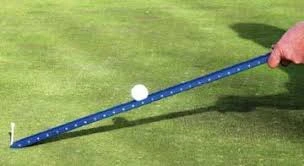
Green speed is measured with a stimpmeter: a simple ramp that releases a ball onto a flat part of the green. The reading is how many feet it rolls. Most public courses run around 8 to 9. Super Quick greens, like Augusta National's, run 11 to 12. Ultra Fast greens, like Oakmont's, where the stimpmeter was first used, run 13 to 15. Before you play, ask the PGA professional or the superintendent for the day's reading.
03 — Reading a chart.
Find your distance down the left side and your club across the top. Where they meet is your landing zone.
| YDS | LW | SW | GAP | PW | 9I |
|---|---|---|---|---|---|
| 10 | 5.5 | 5.0 | 4.5 | 4.0 | 3.5 |
| 11 | 6.0 | 5.5 | 5.0 | 4.5 | 4.0 |
| 12 | 6.5 | 6.0 | 5.5 | 5.0 | 4.5 |
| 13 | 7.0 | 6.5 | 6.0 | 5.5 | 5.0 |
| 14 | 7.5 | 7.0 | 6.5 | 6.0 | 5.5 |
| 15 | 8.0 | 7.5 | 7.0 | 6.5 | 6.0 |
| 16 | 8.5 | 8.0 | 7.5 | 7.0 | 6.5 |
| 17 | 9.0 | 8.5 | 8.0 | 7.5 | 7.0 |
| 18 | 9.5 | 9.0 | 8.5 | 8.0 | 7.5 |
| 19 | 10.0 | 9.5 | 9.0 | 8.5 | 8.0 |
| 20 | 10.5 | 10.0 | 9.5 | 9.0 | 8.5 |
04 — The RC6².
6 FT × 6 FT · EIGHT TEES · 2 FT THIRDS
- Find a flat, quiet area of the practice green and a clean lie in short grass.
- Drop 8–10 balls just off the green.
- Pace off 20 yards from your balls to a hole — or a tee as your target.
- On a slow green with a pitching wedge, the chart says 10.0. Pace off 10 yards toward the hole and set a ball marker. That's the center of your Zero Zone.
- Frame the carpet with eight tees: two at 9 yards and two at 11 yards, two yards apart, and four more marking the thirds.
05 — The preference rings.
Land inside the carpet and roll it into one of these rings. Three rings instead of one perfect spot keeps expectations realistic — and the pressure off.
06 — Taking it to the course.
On the course there are no tees to frame the carpet, so use what's there: a discolored patch, an old cup mark, a leaf, a dusting of sand, mower-wheel lines. Lock your eyes on it, pace off your number, and commit. With practice, finding your RC6² takes less than 30 seconds.
07 — Adjusting for conditions.
Grain
Dark, dull grass usually grows toward you; light, shiny grass grows away. Landing into the grain checks the ball sooner; landing with it lets it run.
Wet greens
The ball skids, then stops quickly. Check the practice green and adjust as the course dries out.
Wind
Into the wind slows the ball; downwind carries it farther.
Slope & tiers
On uphill, downhill, elevated or tiered greens, adjust your red carpet. A built-in slope setting is in development.
Rough & bad lies
Double the size of your landing zone. The priority is getting the ball on the green.
The ball
The charts were calibrated with three-piece golf balls. Practice with the same type for consistent results.